



In this article
- The Danger of Cheap Murphy Beds
- Solid Wood vs. Plywood: Where Each Belongs
- Engineered for Safety: Our Proprietary 7-Layer Plywood
- Tested to Hold 4,000+ Pounds
- A Deep Dive into Our Materials
- Species of Wood We Use
- Frequently Asked Questions
The Danger of Cheap Murphy Beds: Why Material Choice is a Safety Issue
Search “Murphy bed recall” online and you will find over 120,000 units recalled due to catastrophic failure—including incidents resulting in severe injuries and deaths.
In every major recall, the root cause is the same: particleboard or other fake wood.
Unlike traditional stationary beds, a Murphy bed is a moving structure under constant leverage. Every time you pull the bed down, the metal mechanisms pull against the anchors holding the bed to your wall and frame. Particleboard is made of compressed sawdust and glue; under repeated operating tension, the screw holes strip, the fasteners tear through the board, and the entire structure pulls off the wall.
Real wood beds don’t fall off walls. That is why Wilding Wallbeds is strictly committed to using zero particleboard, pressboard, or cheap fillers in our construction.
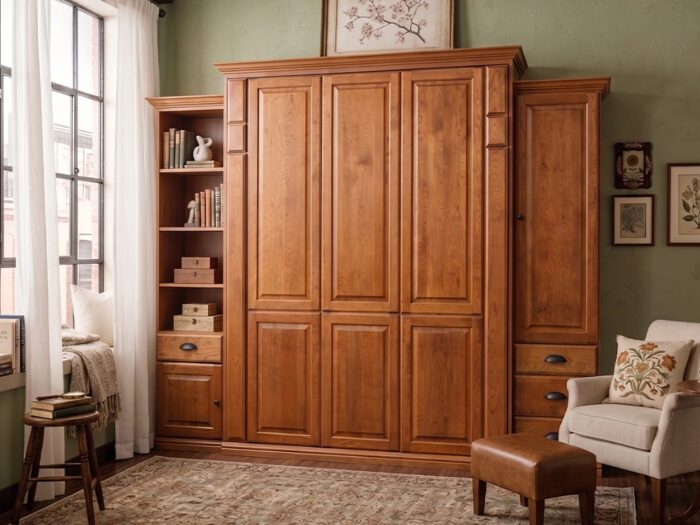
Solid Wood vs. Plywood: Where Each Belongs
Many buyers assume “100% solid wood” is always the superior choice for furniture. While solid wood is exceptional for small parts like chair legs or crown molding, using it for large flat panels in a Murphy bed would actually cause the bed to fail.
Solid wood expands, contracts, bows, and warps when humidity changes. If a massive 6-foot panel on the face of a Murphy bed warps even slightly, the door won’t latch, the alignment fails, and the bed binds up.
At Wilding Wallbeds, the philosophy is simple: we place the right material where it performs best:
| Component | Material Used | Why It Matters |
| 5-piece Doors, Moldings, Trims & some Drawer fronts | 100% Solid Wood | Provides rich, natural beauty, crisp detail, and timeless durability. |
| Large Structural Panels & Sideboards | Proprietary 7-Layer Plywood | Eliminates warping, withstands high tension, and keeps the bed operating smoothly for decades. |
| Raised Panel Bed Faces | 100% Solid Wood | Certain styles have raised panel faces. These styles use 100% solid wood faces. |
Our Proprietary Murphy Bed Plywood
Standard off-the-shelf plywood from a local hardware store isn’t designed for the structural demands of a Murphy bed. Recognizing this gap decades ago, we partnered with a specialized mill in the Pacific Northwest to custom-engineer our own proprietary furniture-grade plywood.
The Anatomy of Wilding’s Murphy Bed Plywood
- Hardwood Outer Veneers: Real solid wood species (Oak, Maple, Cherry, etc.) for real wood grain and finish quality.
- Thin MDF Stabilizers: Positioned directly beneath the outer veneers to absorb natural grain imperfections and create a glass-smooth substrate for paint or stain.
- Multi-Ply American Solid Wood Cores: Alternating grain patterns counteract warping forces and give the panel structural rigidity far exceeding raw timber.
Key Takeaway: Our stabilizer layers are not particleboard—they are thin stabilizing sheets engineered to keep painted finishes flawless while preserving the core strength of American solid wood.
Our Beds are Tested to Hold 4,000+ Pounds. The Secret? Our Murphy Bed Plywood.
Because our proprietary Murphy Bed Plywood distributes load forces evenly across cross-laminated layers, our wall beds can handle static weights that would crush traditional furniture.
To demonstrate this strength, we didn’t just calculate formulas—we parked a full-sized car on top of one of our wall bed frames.

A Deep Dive into our Materials
Solid Wood
Solid wood is as natural as it gets—harvested, dried, and milled into usable shapes and sizes. It’s beautiful, warm, and remarkably strong. However, it is not very stable and is highly responsive to moisture changes, which can cause warping, cupping, shrinking, and cracking.
Solid wood is typically produced in planks that range from 6″–12″ wide and 8’–12′ long. Because of this, it cannot be used for large panels (such as the face of a Murphy Bed) unless multiple planks are joined together.
How we use solid wood in our Murphy Beds:
We use solid wood for our five-piece doors, drawer fronts, moldings, trims, and the hidden skeletal structure of some of our wall beds. However, solid wood is not suitable for large structural panels due to its tendency to bow and warp. For over a century, woodworkers have relied on plywood for these applications.
Furniture Grade Plywood
Our Proprietary Murphy Bed Plywood
Murphy Beds are unlike any other cabinetry. Not only are they much larger than standard cabinets, but they also have unique demands:
- The bed face must swing 90º open and closed thousands of times over its lifetime.
- It must support multiple people and a mattress without additional structural supports.
- It needs to be strong, stable, and lightweight for comfortable operation.
Standard plywood is not designed for these conditions, just like automotive steel is unsuitable for an airplane. Airplanes require aircraft aluminum, and Murphy Beds require Murphy Bed plywood.
Decades ago, we realized that existing plywood did not meet our needs. So, we partnered with a lumber mill in the Pacific Northwest to engineer a plywood specifically for Murphy Beds. This proprietary plywood is designed to our exact specifications, and it works fantastically.
Is Plywood a High-Quality Material For Murphy Beds?
There are some who assume that plywood is a cheap alternative to real wood used to save money. This simply is not the case. While there certainly are products that fit that description (I’m looking at you, particleboard), plywood is actually an ingenious solution that solves many of the problems of natural wood. Think of plywood the same way you might think of steel. Steel is not a metal in its natural state, instead it is a combination of natural metals that come together to form a product that is better than the raw elements.
Now, the moment you’ve been waiting for, an answer to the question, “Is plywood high quality?” Well, the truth is, it depends. Because plywood is just layers of wood products, there are countless different plywoods on the market. It would be like asking if all cake is delicious. Certainly some cakes are! Similarly, there are unlimited grades of plywoods available, and some of them are certainly not high-quality. If you’ve had experience with these low-quality plywoods, rest assured that the plywood we use at Wilding Wallbeds is the highest furniture grade plywood, which means it is very high quality.
Did you know that lumber mills generally reserve the best-of-the-best lumber for use in plywood? They use many factors to grade each piece of wood and the highest graded boards are used for plywood veneers.
What’s In Our Plywood?
Our proprietary plywood has seven layers, including two veneers (the thin, outermost layers), stabilizing layers of MDF, and multiple layers of different American solid woods. The stabilizing layers of MDF sit directly beneath the veneers and serve to create a perfectly smooth and stable substrate for the veneer to adhere to.
All wood species, even the smoothest ones like maple, have small imperfections, and those imperfections come screaming through when they are painted. For this purpose, the outermost layers of our paint grade plywood are MDF. This results in a painted product that is nearly flawless–something that no wood species can offer.
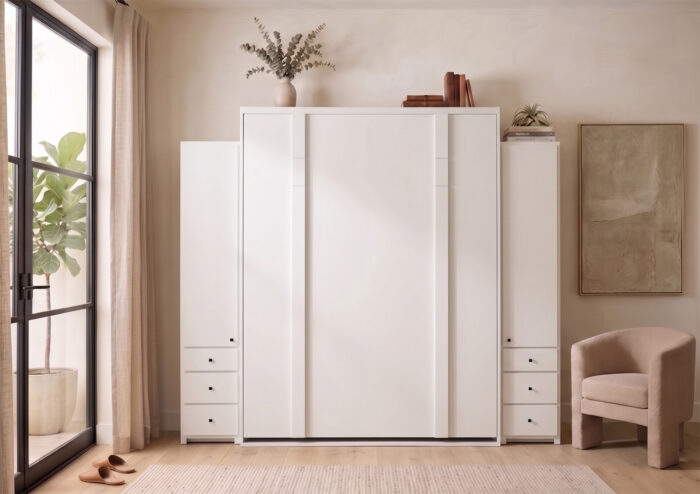
What is Our Paint Grade Wood?
Throughout the 30+ years we have been in business, we have tried and tested several different materials for painting. We originally used our regular alder plywood and solid wood, but we got many complaints from customers that the texture of the wood grain, as well as other small imperfections in the wood, were showing through on the paint job. They wanted it completely smooth. So, we went back to the drawing board to design a plywood that is as strong and durable as our other wood options but paints completely smooth.
This is when we developed our current paint grade wood. We wanted the strength of natural wood, but needed a smoothness and paintability that nature simply cannot provide.
This Paint Grade wood utilizes our standard solid wood ply core (meaning the inner layers of the plywood are the same solid wood layers as our other plywood varieties) with a layer of MDF as a skin. This way, we truly get the strength of real wood (in the plywood core) with the paintability of MDF.
For the solid wood portions of painted beds, we use poplar wood. As far as solid wood goes, it is by far the best option. So, if you were to strip down your paint grade wall bed, you would find our paint grade plywood (solid wood core with MDF skin) and poplar solid wood trim, molding, drawer fronts, etc.
How We Use Our Proprietary Murphy Bed Plywood
We use our Murphy Bed plywood for all of the large structural panels on our Murphy Beds. This includes: sideboards, face panels, bridge boards, headboards, and stretchers. In short, the overall cabinet structure of the beds are constructed from plywood. This is the perfect example of using the material that is best for the job. Because our plywood is so much stronger and more stable than solid wood, our some of Murphy Beds have been tested to over 4,000 lb!
What Species of Wood do We Use?
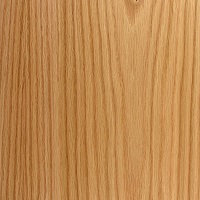
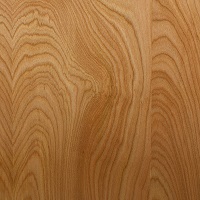
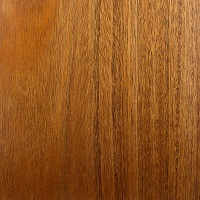
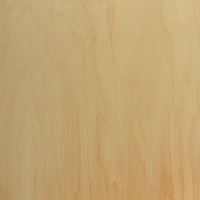
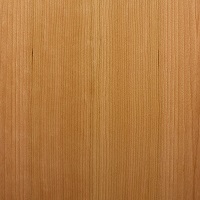
While we have access to almost any species of wood, we carry alder, red oak, hard rock maple, African mahogany, and cherry. For our paint grade orders, we use solid alder or poplar for the trim, doors, and molding. We also routinely work with walnut, quarter sawn oak, pine, upon request.
Common Questions
-
Is your lumber sustainable?
Yes. All of our lumber is harvested sustainably and is sourced from lumber farms in the USA.
-
Does your plywood contain toxins like formaldehyde?
No. Our plywood does not contain any toxic ingredients or VOCs. One of the major benefits of our close partnership with our lumber mill is that we can carefully keep tabs on everything that goes into our lumber. In fact, the glue that holds the layers of our plywood together is edible. That’s a true story, but the flavor is awful.
-
Do you use MDF?
We don’t use solid MDF panels. MDF does one thing solid wood can’t do: it can be perfectly smooth without any defects. Because of this, we use it in two places:
- Stabilizing Layer: When a solid wood veneer is applied to a plywood core, the imperfections of the solid wood ply layers can show up on the veneer. So, we sandwich a layer of MDF between our solid wood veneers and our solid wood ply core to stabilize the veneer.
- Paint Grade Wood: When solid wood is painted, imperfections such as knots can be seen through the paint. So, our paint grade material utilizes MDF as the outer layer (almost like an MDF veneer) on top of our solid wood ply core. This gives our paint grade wood the strength of our solid wood ply core and the paintability of MDF.
Our philosophy on the material we use is simple: we strive to use the best material for the job. Sometimes, that means a thin layer of MDF in combination with our ply core to ensure smooth paintability.
-
Do you use any particleboard?
No. None. You literally will not find a single scrap of particleboard in our entire wood shop.
-
How is plywood different from particleboard?
People tend to believe that anything other than solid wood is inferior. This simply isn’t the case. A single layer of solid wood will warp, crack, and break fairly easily. If you stack together several layers of solid wood with alternating grain directions, you get a much sturdier material: plywood.
Plywood is much stronger, more durable, and more stable than pure solid wood. Using high-grade plywood is not an attempt to cut corners or cut costs—it is truly the better material in some cases.
Particleboard is vastly different. It is small chunks of wood, mixed together with a resin and pressed into a mold. It is the wood equivalent of SPAM. Blended up, glued together, and formed into the shape of a wood panel. Particleboard is much weaker than solid wood. It is incredibly cheap and it is used to cut costs.
Particleboard is also structurally inappropriate for a Murphy Bed. The size, weight, and tension of a Murphy Bed all require higher quality. Particleboard simply doesn’t make the cut. -
What parts of your bed are solid wood vs plywood?
We use solid wood for trim, molding, supports, crown, and some drawer fronts and doors. Raised panel beds have a bed face that is truly 100% solid wood.
We use our proprietary Murphy Bed Plywood for structural elements like the side boards, headboard, stretchers, etc.
Our philosophy is to use the right material for the job. Sometimes plywood is the better choice and sometimes solid wood is.